


By Role
Construction Management Software for Financial Managers
Pay and bill from verified work, see overruns before month-end, and close the books on the same numbers your field crews reported.
Trusted by Industry Leaders

Finance does not rebuild quantities from spreadsheets. Each step happens in one platform, so what you approve is what you bill and what you pay.

Step 1
Field production arrives with quantities, photos, and markups. Only approved reports count as verified work.
Step 2
Unit, tiered, regional, and conditional rates are set once per program and subcontract, then applied to every approved quantity.
Step 3
Group verified pay items into receivables for the client and payables for subcontractors. Finalized invoices lock.
Step 4
Receivables, payables, budget, and cost reconcile to the same verified quantities, with exports to your accounting or ERP system.
What Finance Teams Get From Vitruvi
Pay and Bill Without Rebuilding Quantities
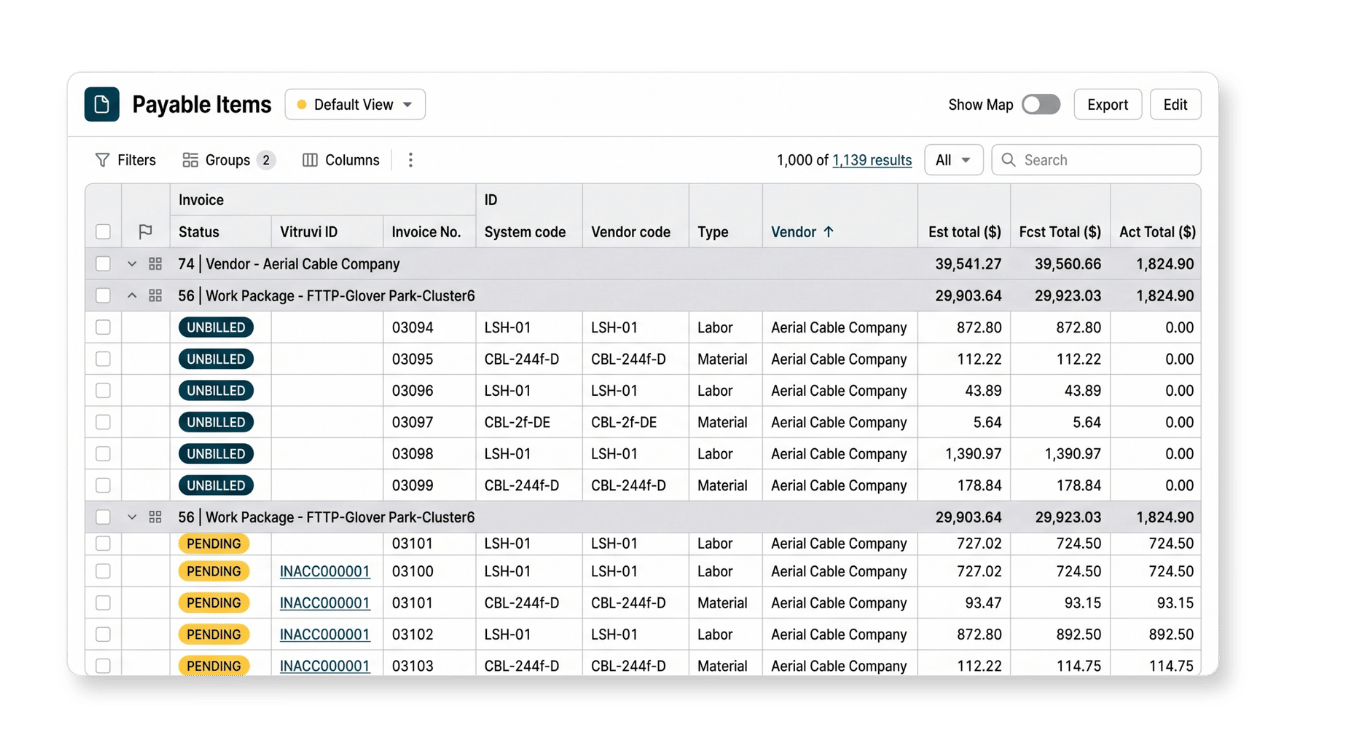
Stop reconciling spreadsheets before every invoice. Approved production becomes pay items automatically, so finance reviews and finalizes instead of re-keying.
-
Production-based billing: pay items created when reports are approved
-
Contract pricing: unit, tiered, regional, and conditional rates
-
Invoice control: pending, invoiced, and paid, locked when final
-
Milestone and timesheet billing: on the same invoice
-
Corrections: disputes reopen invoices, true-ups square the total
“It took two to three people a couple of days to try to invoice 1-2 customers weekly. Now project managers can handle it themselves, and it doesn’t eat up their whole day.”
Systems Administrator, EPC
See Budget, Cost, and Margin as Work Happens
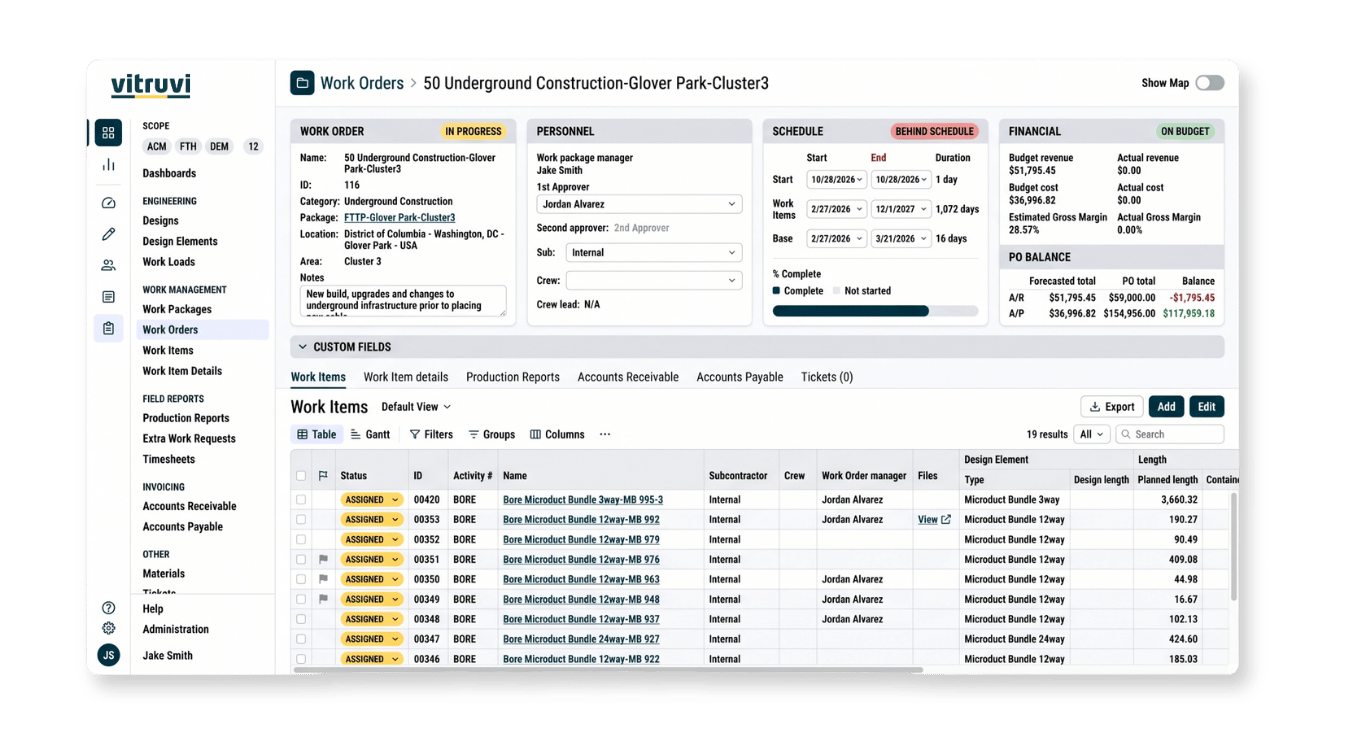
Catch overruns while you can still act. Budgeted and actual revenue, cost, and margin update by work order as production comes in, not at month-end.
-
Real-time budget tracking: based on reported production, not estimates
-
Margin by work order: revenue, cost, and margin together
-
Financial dashboards: budget, cost, and billing in one view
-
Purchase order balances: remaining balance updates as invoices are issued
“We’re probably saving one to three people in finance and two to three QC people per region.”
Senior Director of Program Management, Highline
Close the Books With an Audit-Ready Trail
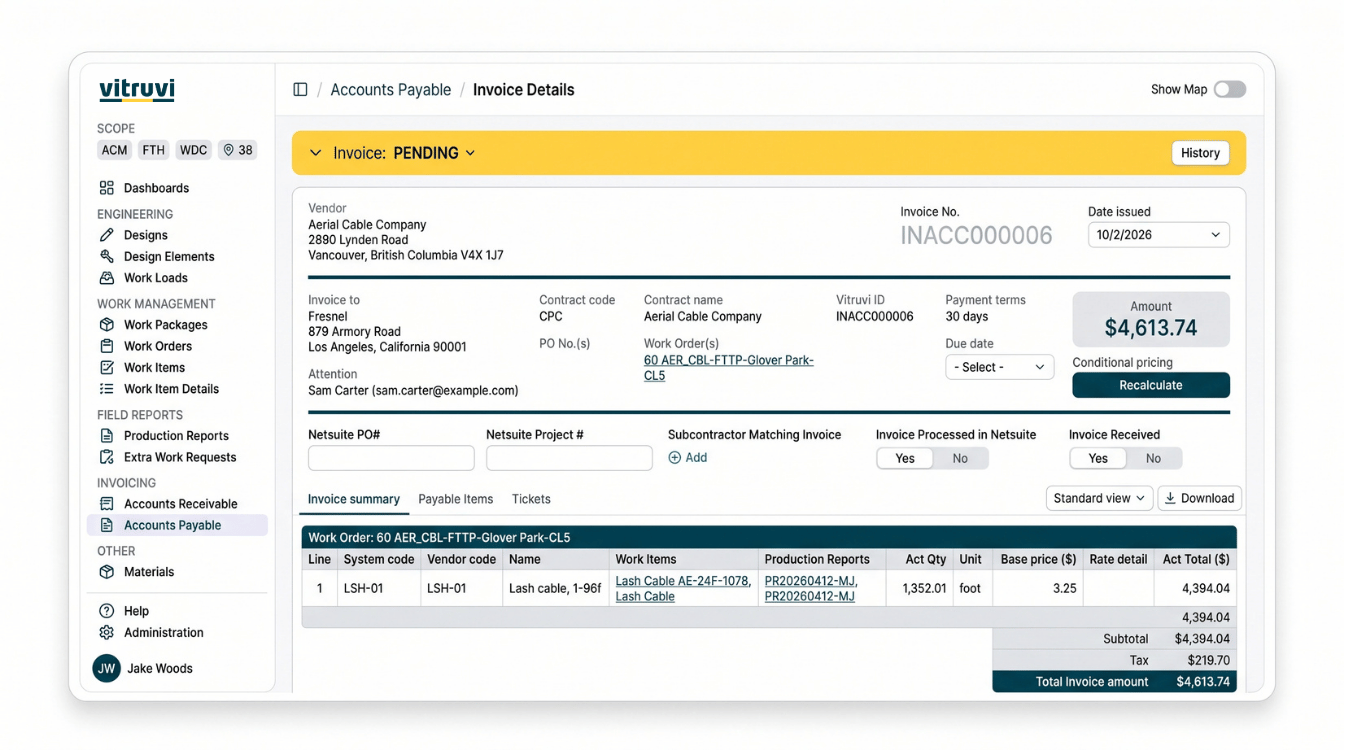
Reconcile on the same verified quantities. Receivables and payables come from one record, with a trail from the field report to the final payment.
-
A/R and A/P alignment: each party sees only its side
-
Tax codes by region: multiple tax types per invoice
-
Audit-ready trail: from field report to payment
-
Accounting and ERP exports: no manual re-entry. See Reporting & Analytics

Finance Works Best When Everyone Shares the Same Data
Project Managers
Track budget, cost, and margin as production comes in, and hand finance clean, approved quantities.
Engineering Managers
Keep design and as-built data aligned with what gets priced, approved, and billed.
Financial Management Platform
Explore every billing, cost control, and reporting capability behind the finance workflow.
Paid on Verified Work
FAQs for Financial Managers in Construction
What is construction management software for financial managers?
It connects budgets, pricing, invoicing, and payables to the work actually built. Vitruvi does this for linear infrastructure projects, so finance works from approved field production instead of spreadsheets and status calls. For the full capability list, see the Financial Management platform page.
How can finance teams prevent revenue leakage?
Pay items are created from approved production, and only verified work can be invoiced. Unbilled work is visible by work order, so completed work does not slip through before close-out.
How does Vitruvi help finance see budget overruns early?
Budgeted and actual revenue, cost, and margin update by work order as production is reported, so variances show up during the project, not at month-end.
Can finance control what contractors are paid?
Yes. Contractors are paid on the quantities they report and your team approves. Each pay item links back to the production report behind it, and rejected reports go back with a reason.
How are payables and receivables kept aligned?
Each priced quantity can generate a receivable to the client and a payable to the subcontractor from the same record. Each party sees only its own side, so both stay tied to the same verified work.
What pricing structures can finance configure?
Unit rates, tiered pricing, conditional adjustments by date, region, or program segment, regional rate cards by subcontract, and milestone-based progress pay items.
How do corrections and disputes work?
A disputed invoice reopens for edits and can be finalized again once resolved. True-ups add or subtract quantities so the final total matches the work completed. Finalized invoices lock so billed amounts stay consistent.
Does Vitruvi connect to our accounting or ERP system?
Yes. Financial data exports to accounting and ERP systems, removing manual re-entry. Learn more on the Reporting & Analytics page.
Does Vitruvi handle taxes, purchase orders, and timesheets?
Yes. Tax codes can be assigned by region, purchase order balances are tracked against each work order, and approved timesheets generate pay items for regular, overtime, and double-time hours.